Friday, July 10, 2015

10 Story Time Extension Activities for Early Elementary Audiences


It seems like I frequently see librarians asking for suggestions for story time extension activities to share with older kids - usually Kindergarten to grade 2 or 3. Though sometimes kids in this age group simply like to sit and hear stories, there are some types of other activities they really do enjoy. I've decided to post my list of favorites here so that they are all in one place for easy access.

1. Taba Naba

This song by the Wiggles, heard here on YouTube, appears on a video that is clearly intended for preschoolers, but the movements - which are essentially dance steps performed while sitting down - are definitely too challenging for most three and four year olds. It is older kids who are drawn to them, and who enjoy practicing to get the motions to match up properly with the rhythm. What works best is to memorize the words and sing the song a cappella. That way, you can vary the pace of the music according to the abilities of your group, and speed up as they get better. Another option is to practice several times through without the recording, and then try to keep up with the recording. This song works well with kids in all grades, even at the upper elementary level.


2. Interactive Aikendrum 

Aikendrum is probably the song I play best on the ukulele, so it is a staple of my story time sessions. A couple of years ago, a first grade class helped me come up with a way to involve  the audience directly in singing the song. Instead of me singing the traditional lyrics - his eyes were made of meatballs, his nose was made of cheese, etc. - I invite the kids to choose a part of Aikendrum's body and a food to represent it. Your mileage may vary on this one. Though it has not yet happened to me, there is always the possibility that a child will choose a part of the anatomy that is not appropriate to discuss in story time. Usually, though, you will get responses like, "his legs were made of pretzels" and "his eyes were made of grapes" which give you a lot of insight into the creative minds of elementary school kids.


3. The Banana Dance 

Dr. Jean's Banana Dance became an obsession for me and a former coworker one summer, and we performed it together every chance we got. It really requires you to ham it up - the more foolish you look and feel, the better the chances are that you are performing it properly. The tune is tricky and the motions require some practice so definitely don't introduce this one in a program without trying it first on your own, but the rehearsal is worth the end result. Especially rewarding are the puzzled looks on the faces of the parents or teachers in the room who can't quite believe grown people are dancing around like various foods.


4. Tooty Ta

Tooty Ta is a song I have never performed in public (and likely never will), but I know many people - my mom included - who swear by it. It's another Dr. Jean favorite, which will make you look even more ridiculous than the Banana Dance.


5. Hat, Coat, Pants, and Shoes

I wrote the lyrics to this song, which is modeled after Head, Shoulders, Knees, and Toes and sung to the tune of London Bridge. Each verse begins as follows:

Hat, coat, pants and shoes
Pants and shoes, pants and shoes
Hat, coat, pants and shoes
Glasses...

Pause dramatically after glasses, holding your note to build suspense, and then move your hands quickly to a silly position and name something silly the kids could be wearing. Some of my go-to favorites are bat wings, moose antlers, squirrel tail, party hat, bow tie, mittens, and wristwatch.

In the summer months, and when promoting summer reading, I adapt the song to suit summer clothing, and change the words to "Visor, T-Shirt, Shorts, and Shoes."


6. Bag of Verbs

This is a game I invented to use in my Read-Along Story Times for Beginning Readers. I printed out a set of interesting verbs, cut them apart, and put them in a paper bag. At the halfway point of the story time, I brought out the bag and invited each child to take a turn choosing a word for the group to act out. Kids who could sound out words enjoyed decoding each verb, but even those who did not yet read usually got a kick out of being invited to move around the room and act silly. This is my go-to activity for kids who feel that music is too babyish.


7. Quick as a Cricket Flannel Board Game

This is a classic picture book I loved in childhood, which works really well as a flannel board guessing game. I printed out the clip art for the book provided by kizclub.com, which includes a sentence strip for building the sentences from the story. When I present it, I put the adjectives up on the flannel board one at a time and have the kids guess which animal each one describes. When I have heard a fair number of guesses, I show the picture to reveal the correct answer. This works well in groups of all sizes - I've had groups of 40 kindergarteners enjoy it just as much as small audiences of 3 or 4 preschoolers. See a photo of the flannel board in action here. (Note: Because I only had travel flannel boards, I needed two to hold all the pieces. If you have a larger flannel board, you will definitely need it!)


8. Ears Hear

This poem by Lucia and James L. Hymes, Jr. appears in Read-Aloud Rhymes for the Very Young, selected by Jack Prelutsky. Just as the Bag of Verbs invites kids to move in fun ways, this poem encourages them to make funny sounds. The room can get quite loud, especially with a large group, so it is usually wise to have the door closed and to invite teachers, parents and younger siblings to cover their ears for sounds like "shout" and "scream." If your group is a little older, you can also try turning the poem into a guessing game as I did for this story time.


9. Making Lists

Early elementary kids love to share their thoughts on anything and everything. Channel their energy into a list-making activity. On a piece of poster board or chart paper (or on a chalkboard, white board, PowerPoint slide, etc.) post a question for the kids to answer. Then record each child's answer and display the list in the story time room or other suitable location. Suggested topics include:

  • If you could wish on a star, what would be your wish? 
  • What do you like most about the library? 
  • Can you name something green? 
  • Do you have a pet? If so, what is it? 
This concept would also work as an ongoing display for your library or classroom. Leave markers and poster board out and let any child who wants to participate add his or her thoughts to the list. 


10. Happy/Sad Faces

Another way to engage kids' inherent desire to express their opinions is to provide happy and sad faces to each child. (I usually print out paper faces and tape them to popsicle sticks, but you could use more durable materials if desired.) Ask the kids yes and no questions - or read a book posing such questions - and allow them to show you their opinion by holding up the appropriate face. This activity is really good for small, quiet groups who might be shy about participating, as well as very large groups where there isn't time for every child to express an individual opinion.


How do you engage older kids in story time? Share your favorite activities below!

Wednesday, July 8, 2015

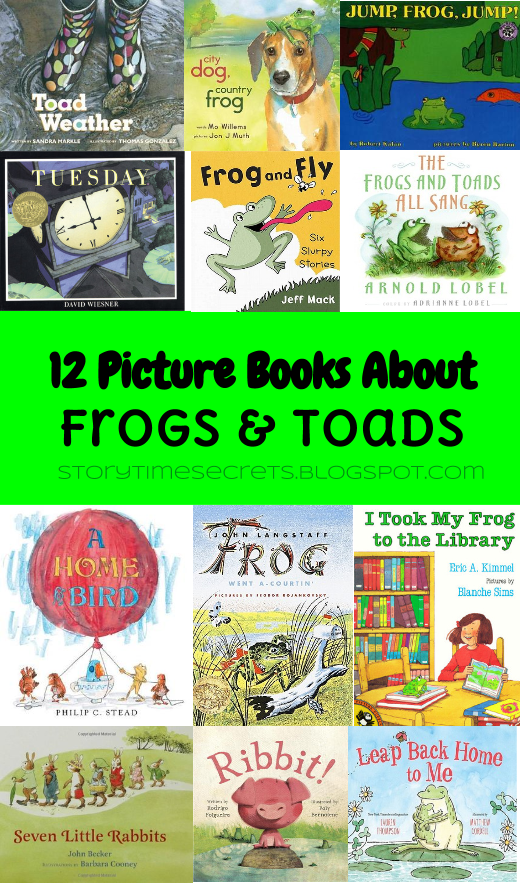
12 Picture Books about Frogs & Toads


After receiving a review copy of Toad Weather in the mail recently, I compiled this list of picture books, all of which involve a frog and/or a toad.

  • Toad Weather by Sandra Markle, illustrated by Thomas Gonzalez
    On a rainy day, Ally's mother takes Ally and her grandmother outside to see something amazing  - a toad migration! This is a great STEM-themed title for families to read together. 
  • Jump, Frog, Jump! by Robert Kalan, illustrated by Byron Barton
    In this cumulative story about the food chain, a frog must jump to avoid various dangers and stay alive.  
  • Frog Went a-Courtin' by John Langstaff, illustrated by Feodor Rojankovsky
    A beloved folk song about the marriage of a frog and a mouse is fully illustrated in this classic picture book originally published in 1955. 
  • City Dog, Country Frog by Mo Willems, illustrated by Jon J. Muth
    When a city dog visits the country, he makes fast friends with a frog, only to wonder where he has gone when he returns during the winter. (This is a surprisingly serious and poignant story for funny man Mo Willems!)
  • Frog and Fly by Jeff Mack
    In a series of simple stories, a frog meets a fly and finds a way to outsmart him - until one day the tables are turned! This is a perfect picture book for beginning readers to enjoy on their own.
  • The Frogs and Toads All Sang by Arnold Lobel, illustrated by Adrianne Lobel
    This lesser-known Arnold Lobel work, published years after his death and illustrated by his daughter, is a collection of rhyming stories about frogs and toads. 
  • Tuesday by David Wiesner
    This winner of the 1992 Caldecott Medal is nearly wordless, and it depicts one surreal Tuesday night on which frogs rise on their lilypads and levitate ominously through their town.
  • A Home for Bird by Philip C. Stead
    With help from Skunk and Porcupine, a toad named Vernon makes it his mission to find a home for the small, silent blue bird he has found. 
  • Seven Little Rabbits by John Leonard Becker, illustrated by Barbara Cooney
    In this rhythmic, repetitive tale, seven little rabbits make their way down the road to visit their old friend toad, but many of them are waylaid by the temptation to nap. 
  • Ribbit by Rodrigo Folgueira, illustrated by Poly Bernatene
    The peaceful lives of a group of frogs are upset when a pig comes along and begins to act as they do. 
  • Leap Back Home to Me by Lauren Thompson, illustrated by Matthew Cordell
    No matter how far the baby frog leaps from his mother, she always welcomes him home again with open arms. (Like Matthew Cordell? Check out this list of books he has illustrated!)
  • I Took My Frog to the Library by Eric A. Kimmell, illustrated by Blanche Sims
    This imaginative introduction to proper library behavior explores what could happen if kids brought their pets to the library.

Tuesday, July 7, 2015

Moms Club Story Time, 6/29/15

My June story time for the Moms Club got rained out earlier in the month, but we had a beautiful day for this rescheduled date. We had a great turn-out; our only complication was that the pavilion where we met was also being used by a local kids' tennis club. Thankfully, we were able to sneak in just after their snack time and before parents started coming to pick up their kids, so we didn't disturb them too much, and they didn't get in our way. (I do wish there was a way to know when that pavilion is being used. I don't think it can be reserved, so we are always guessing!)

The kids in attendance ranged in age from 1 month to 4 years, and I aimed for the middle of that age range, since most of the kids hovered between 18 months and 2 years. This is what I performed:

Hello Song with ukulele: Hello, how are you?

Song: If You'd Like to Read a Book

Book: Stanley the Farmer by William Bee
We have had this book for months, and I've been itching to spread the word about Stanley to my mom friends. I don't think anyone is as excited about this series as I am, but I was glad to be able to share it!

Flannel Board Song: Stanley's Tractor 
I used clipart from the publisher's website to make flannel board pieces to accompany Stanley the Farmer, then wrote up some lyrics to the tune Mary Wore Her Red Dress and shared it on my homemade handheld flannel board. The kids were probably the most interested in this one, and Little Miss Muffet only cried a little bit when I said she couldn't hold Stanley until we got home.

Book: Mr. Gumpy's Outing by John Burningham
The oldest kids in the group liked this one a lot, and one little boy eagerly called out the names of the animals.

Song with Ukulele: Five Rowers in a Boat 
I learned this one for ukulele after hearing it on Spotify. The original song starts with eight rowers, but I cut it down to five for the sake of everyone's sanity.

Flannel Board Rhyme: Seven Snazzy Aunties
This rhyme used to work for me a few years ago, but at this story time, as in others toward the end of my time at the library, it was met with silence. I am not using it anymore. Really this time.

Book: The Bus is for Us by Michael Rosen
I don't like this quite as much as The Bus for Us by Suzanne Bloom, but I wanted to try it out since it's new. The kids seemed fairly into it, though I think it was too basic for the preschoolers and one book too many for the little guys.

Song: The Wheels on the Bus

Song with Ukulele: ABCs
This was going to be my usual medley but the tennis kids returned to the pavilion just as the ABCs were coming to an end, so I cut us off and went right into the goodbye song.

Goodbye Song: We Wave Goodbye Like This 

I will have two more programs to post about in the month of July. This Friday, I'm doing a school-aged nature story time for the summer camp where my mom works, and later in the month, I'm hosting a ukulele sing-along for the Moms Club. I look forward to sharing those plans here on the blog!

Friday, July 3, 2015

Early Literacy in Everyday Places: Baseball Game


If you and your family plan to attend a major or minor league baseball game this summer, this post is for you! Below are four suggestions for literacy activities you can do with your kids in a baseball stadium.
  • Talk about the letters of the players’ names when they appear on the Jumbotron. Encourage your child's print awareness and letter recognition skills by talking about the letters in their favorite players' names. If a player happens to share a name with your child, challenge him to look for it each time that player goes up to bat. The jumbotron is also a good place to look for other print material throughout the game, as it is often where birthday messages, advertising, and other information is presented. 
  • Explain baseball vocabulary such as strike, ball, hit, run, and out. Toddlers might not understand the rules of baseball just yet, but you can still go over the basic vocabulary. For added fun, have them try to count strikes for each out, and outs for each inning. 
  • Encourage your kids to sing “Take Me Out to the Ballgame” during the 7th inning stretch. How often do we really have the chance to join in a group sing-along? Don't miss out! To get your kids geared up for this tradition, practice singing the song before the game, or read a picture book version of the song, such as the ones by Ben Nussbaum or Maryann Kovalski.
  • Act out the "Five Little Hot Dogs" fingerplay. Whether you actually eat hot dogs at the ballpark or not, this rhyme will get your kids in the spirit of the game! Words for the rhyme can be found here
Related Posts Plugin for WordPress, Blogger...