Wednesday, July 15, 2015

12 Picture Books About Sheep & Goats

"Baa" and "maa" along as you share these picture books about sheep and goats with your little ones!

Sheep

  • Where is the Green Sheep? by Mem Fox, illustrated by Judy Horacek
    There are sheep of all colors and persuasions on the pages of this book, but the location of the green sheep remains a mystery until the very end. 
  • Sheep in a Jeep by Nancy Shaw, illustrated by Margot Apple
    This silly rhyming story shows what happens when a herd of sheep try to drive a jeep. 
  • When Sheep Sleep by Laura Joffe Numeroff, illustrated by David McPhail
    This story recommends other animals to call upon if you want to count sheep, but they have all fallen asleep! 
  • Baa Baa Black Sheep by Iza Trapani
    In Iza Trapani's expansion of this favorite nursery rhyme, the black sheep is generous with her wool, even when her friends are somewhat ungrateful. 
  • Mary Had a Little Lamb by Sarah Josepha Hale, illustrated by Salley Mavor
    This illustrated version of the favorite nursery rhyme includes all of Sarah Josepha Hale's original words accompanied by Salley Mavor's signature hand-stitched scenes. 
  • Time to Sleep, Sheep the Sheep by Mo Willems
    In this simple story, Cat the Cat must inform all of her friends - including Sheep the Sheep - that bedtime has arrived. 

Goats

  • G is for Goat by Patricia Polacco
    There is a goat for every letter of the alphabet in this preschool-friendly book by Patricia Polacco.
  • Oh, Look! by Patricia Polacco
    In a style similar to Michael Rosen's We're Going on a Bear Hunt, a herd of goats escapes from its pen and runs all the way to the county fair, where the goats are startled by an ogre! 
  • Let’s Count Goats by Mem Fox, illustrated by Jan Thomas
    On each page of this silly book, the reader is invited to count goats who are distinguished by various clothing styles and specific actions. 
  • The Three Billy Goats Gruff by Paul Galdone
    This classic adaptation of a favorite fairy tale features a trio of wide-eyed, realistic-looking goats and a scary (but not too scary!) troll. 
  • Grumpy Goat by Brett Helquist
    The new goat on the farm wants to be left alone to eat in peace, until one day a dandelion changes how he sees the world. 
  • Gregory, The Terrible Eater by Mitchell Sharmat, illustrated by Jose Aruego and Ariane Dewey
    Gregory, a picky young goat, refuses to eat trash like the other goats and instead prefers fruits and vegetables. 

Tuesday, July 14, 2015

Why I Won't Read Go Set a Watchman

To Kill A Mockingbird was the best book I read in all four years of high school, and for years afterward, it was the title I gave when I was asked to name my favorite book. (Now I usually name a children's book because that is primarily what I read, but To Kill a Mockingbird is still among my favorite novels for grown-ups, and it's still my answer when "serious" grown-ups are the ones posing the question.) Despite my love for the novel, however, I could not be less interested in Go Set a Watchman, which comes out today, and I do not plan to read it. There are four main reasons:

  1. I am still suspicious of the circumstances under which this book is being published. I have always admired Harper Lee for her willingness to walk away after writing just one great book, and I find it hard to believe that she is suddenly interested in having the public read what is essentially a rough draft of her beloved classic. It strikes me as suspicious that this decision came about only after Lee's sister died, and during a time when she is living in an assisted living facility. It doesn't sit right with me, and deep down, I don't think this is what Harper Lee truly wants.
  2. It was never intended to be a sequel. I've already read several articles talking about how the representation of Atticus in Go Set a Watchman has "ruined" readers' visions of him and caused them to question their devotion to his character. My response is that of course it has! Go Set a Watchman is not a continuation of To Kill A Mockingbird; it's essentially the writing exercise that led to To Kill a Mockingbird. I might be interested in a true sequel, but this is not that. I don't want to know what might have been. I appreciate To Kill a Mockingbird as it was originally published.
  3. It is a guaranteed disappointment. There is absolutely no way a second Harper Lee book published 55 years after the first can live up to the anticipation and hype surrounding it. Even if I found that I kind of liked Go Set a Watchman, it would still be a let-down compared with To Kill a Mockingbird. Why set myself up? There are plenty of other books for me to enjoy.
  4. Ignorance is bliss. If Go Set a Watchman is going to ruin To Kill a Mockingbird for me, or if there is some revelation about a character that would forever change my reading of the original novel, I am better off not knowing anything about it at all. There is nothing about To Kill a Mockingbird that leaves me feeling unsatisfied or that I have been deprived of a proper resolution. I think, for true fans of the classic novel, Go Set a Watchman is a can of worms best left unopened. 

Are you planning to read Go Set a Watchman? Why or why not? 

Friday, July 10, 2015

10 Story Time Extension Activities for Early Elementary Audiences


It seems like I frequently see librarians asking for suggestions for story time extension activities to share with older kids - usually Kindergarten to grade 2 or 3. Though sometimes kids in this age group simply like to sit and hear stories, there are some types of other activities they really do enjoy. I've decided to post my list of favorites here so that they are all in one place for easy access.

1. Taba Naba

This song by the Wiggles, heard here on YouTube, appears on a video that is clearly intended for preschoolers, but the movements - which are essentially dance steps performed while sitting down - are definitely too challenging for most three and four year olds. It is older kids who are drawn to them, and who enjoy practicing to get the motions to match up properly with the rhythm. What works best is to memorize the words and sing the song a cappella. That way, you can vary the pace of the music according to the abilities of your group, and speed up as they get better. Another option is to practice several times through without the recording, and then try to keep up with the recording. This song works well with kids in all grades, even at the upper elementary level.


2. Interactive Aikendrum 

Aikendrum is probably the song I play best on the ukulele, so it is a staple of my story time sessions. A couple of years ago, a first grade class helped me come up with a way to involve  the audience directly in singing the song. Instead of me singing the traditional lyrics - his eyes were made of meatballs, his nose was made of cheese, etc. - I invite the kids to choose a part of Aikendrum's body and a food to represent it. Your mileage may vary on this one. Though it has not yet happened to me, there is always the possibility that a child will choose a part of the anatomy that is not appropriate to discuss in story time. Usually, though, you will get responses like, "his legs were made of pretzels" and "his eyes were made of grapes" which give you a lot of insight into the creative minds of elementary school kids.


3. The Banana Dance 

Dr. Jean's Banana Dance became an obsession for me and a former coworker one summer, and we performed it together every chance we got. It really requires you to ham it up - the more foolish you look and feel, the better the chances are that you are performing it properly. The tune is tricky and the motions require some practice so definitely don't introduce this one in a program without trying it first on your own, but the rehearsal is worth the end result. Especially rewarding are the puzzled looks on the faces of the parents or teachers in the room who can't quite believe grown people are dancing around like various foods.


4. Tooty Ta

Tooty Ta is a song I have never performed in public (and likely never will), but I know many people - my mom included - who swear by it. It's another Dr. Jean favorite, which will make you look even more ridiculous than the Banana Dance.


5. Hat, Coat, Pants, and Shoes

I wrote the lyrics to this song, which is modeled after Head, Shoulders, Knees, and Toes and sung to the tune of London Bridge. Each verse begins as follows:

Hat, coat, pants and shoes
Pants and shoes, pants and shoes
Hat, coat, pants and shoes
Glasses...

Pause dramatically after glasses, holding your note to build suspense, and then move your hands quickly to a silly position and name something silly the kids could be wearing. Some of my go-to favorites are bat wings, moose antlers, squirrel tail, party hat, bow tie, mittens, and wristwatch.

In the summer months, and when promoting summer reading, I adapt the song to suit summer clothing, and change the words to "Visor, T-Shirt, Shorts, and Shoes."


6. Bag of Verbs

This is a game I invented to use in my Read-Along Story Times for Beginning Readers. I printed out a set of interesting verbs, cut them apart, and put them in a paper bag. At the halfway point of the story time, I brought out the bag and invited each child to take a turn choosing a word for the group to act out. Kids who could sound out words enjoyed decoding each verb, but even those who did not yet read usually got a kick out of being invited to move around the room and act silly. This is my go-to activity for kids who feel that music is too babyish.


7. Quick as a Cricket Flannel Board Game

This is a classic picture book I loved in childhood, which works really well as a flannel board guessing game. I printed out the clip art for the book provided by kizclub.com, which includes a sentence strip for building the sentences from the story. When I present it, I put the adjectives up on the flannel board one at a time and have the kids guess which animal each one describes. When I have heard a fair number of guesses, I show the picture to reveal the correct answer. This works well in groups of all sizes - I've had groups of 40 kindergarteners enjoy it just as much as small audiences of 3 or 4 preschoolers. See a photo of the flannel board in action here. (Note: Because I only had travel flannel boards, I needed two to hold all the pieces. If you have a larger flannel board, you will definitely need it!)


8. Ears Hear

This poem by Lucia and James L. Hymes, Jr. appears in Read-Aloud Rhymes for the Very Young, selected by Jack Prelutsky. Just as the Bag of Verbs invites kids to move in fun ways, this poem encourages them to make funny sounds. The room can get quite loud, especially with a large group, so it is usually wise to have the door closed and to invite teachers, parents and younger siblings to cover their ears for sounds like "shout" and "scream." If your group is a little older, you can also try turning the poem into a guessing game as I did for this story time.


9. Making Lists

Early elementary kids love to share their thoughts on anything and everything. Channel their energy into a list-making activity. On a piece of poster board or chart paper (or on a chalkboard, white board, PowerPoint slide, etc.) post a question for the kids to answer. Then record each child's answer and display the list in the story time room or other suitable location. Suggested topics include:

  • If you could wish on a star, what would be your wish? 
  • What do you like most about the library? 
  • Can you name something green? 
  • Do you have a pet? If so, what is it? 
This concept would also work as an ongoing display for your library or classroom. Leave markers and poster board out and let any child who wants to participate add his or her thoughts to the list. 


10. Happy/Sad Faces

Another way to engage kids' inherent desire to express their opinions is to provide happy and sad faces to each child. (I usually print out paper faces and tape them to popsicle sticks, but you could use more durable materials if desired.) Ask the kids yes and no questions - or read a book posing such questions - and allow them to show you their opinion by holding up the appropriate face. This activity is really good for small, quiet groups who might be shy about participating, as well as very large groups where there isn't time for every child to express an individual opinion.


How do you engage older kids in story time? Share your favorite activities below!

Wednesday, July 8, 2015

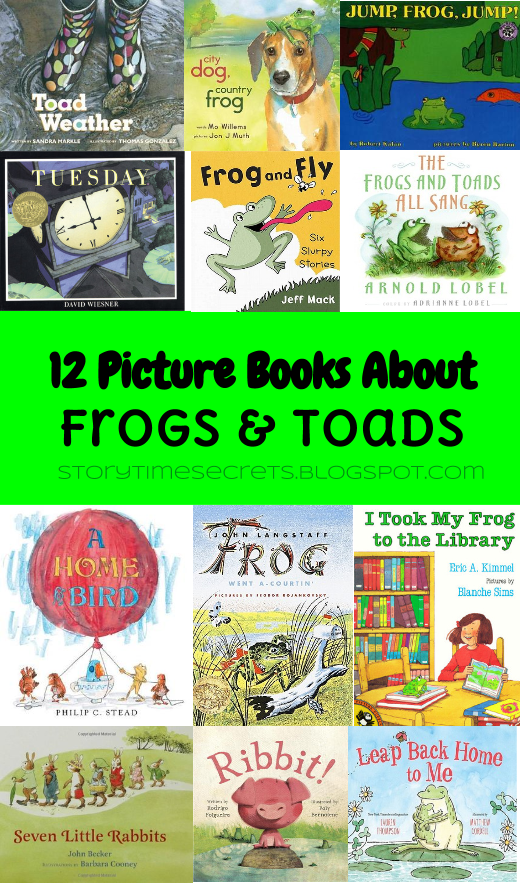
12 Picture Books about Frogs & Toads


After receiving a review copy of Toad Weather in the mail recently, I compiled this list of picture books, all of which involve a frog and/or a toad.

  • Toad Weather by Sandra Markle, illustrated by Thomas Gonzalez
    On a rainy day, Ally's mother takes Ally and her grandmother outside to see something amazing  - a toad migration! This is a great STEM-themed title for families to read together. 
  • Jump, Frog, Jump! by Robert Kalan, illustrated by Byron Barton
    In this cumulative story about the food chain, a frog must jump to avoid various dangers and stay alive.  
  • Frog Went a-Courtin' by John Langstaff, illustrated by Feodor Rojankovsky
    A beloved folk song about the marriage of a frog and a mouse is fully illustrated in this classic picture book originally published in 1955. 
  • City Dog, Country Frog by Mo Willems, illustrated by Jon J. Muth
    When a city dog visits the country, he makes fast friends with a frog, only to wonder where he has gone when he returns during the winter. (This is a surprisingly serious and poignant story for funny man Mo Willems!)
  • Frog and Fly by Jeff Mack
    In a series of simple stories, a frog meets a fly and finds a way to outsmart him - until one day the tables are turned! This is a perfect picture book for beginning readers to enjoy on their own.
  • The Frogs and Toads All Sang by Arnold Lobel, illustrated by Adrianne Lobel
    This lesser-known Arnold Lobel work, published years after his death and illustrated by his daughter, is a collection of rhyming stories about frogs and toads. 
  • Tuesday by David Wiesner
    This winner of the 1992 Caldecott Medal is nearly wordless, and it depicts one surreal Tuesday night on which frogs rise on their lilypads and levitate ominously through their town.
  • A Home for Bird by Philip C. Stead
    With help from Skunk and Porcupine, a toad named Vernon makes it his mission to find a home for the small, silent blue bird he has found. 
  • Seven Little Rabbits by John Leonard Becker, illustrated by Barbara Cooney
    In this rhythmic, repetitive tale, seven little rabbits make their way down the road to visit their old friend toad, but many of them are waylaid by the temptation to nap. 
  • Ribbit by Rodrigo Folgueira, illustrated by Poly Bernatene
    The peaceful lives of a group of frogs are upset when a pig comes along and begins to act as they do. 
  • Leap Back Home to Me by Lauren Thompson, illustrated by Matthew Cordell
    No matter how far the baby frog leaps from his mother, she always welcomes him home again with open arms. (Like Matthew Cordell? Check out this list of books he has illustrated!)
  • I Took My Frog to the Library by Eric A. Kimmell, illustrated by Blanche Sims
    This imaginative introduction to proper library behavior explores what could happen if kids brought their pets to the library.
Related Posts Plugin for WordPress, Blogger...