

Thursday, June 26, 2014
Story Time Secrets Reader Survey

Mommy Librarian's Story Time Secret #1: Sit with the Grandmas!

First I was a children’s librarian. Then I became a mom. As I attend story times with my daughter, I have started to make a list of hints that might be helpful to story time performers and/or story time attendees. Today’s hint is for moms (and dads) who attend story time: When in doubt, sit with the Grandmas!
At every story time I have attended or performed, it seems like there has always been at least one grandmother in attendance. Whether Grandma is the regular caretaker, a one-time babysitter, or an out-of-town visitor, here’s why I recommend sitting next to her whenever possible:
- Grandma knows how to behave at story time. She remembers the old days when story time was about sitting still and listening. While she might not expect the baby in her care to be completely attentive, she will, without a doubt, be respectful of the story time performer and she will probably not elbow you to make a snarky comment about the silly book the librarian is reading.
- Grandma has been there, done that when it comes to meeting other parents, and knows how to smooth over socially awkward situations. Recently, another mom and I were sitting next to the soft blocks after story time, looking back and forth between our babies and each other, struggling for something to say. A grandmother nearby picked up on this and immediately said just the right thing to get the conversation going again.
- Grandma says nice things about your baby. People who have just had their first baby or don’t have children at all often don’t know what to say to a new mom about her baby. Not so with Grandma! Grandmothers give great compliments on your baby’s clothes, eyes, and hair, and they always point out how your baby looks just like you. They never say weird things like, “Your baby grew” (because that’s obvious) or “Do you breastfeed?” (because that's personal.) They know what their own daughter would like to hear and they say those things to you.
Tuesday, June 24, 2014
Fizz Boom Reads: Chapter Books

Though this year's CSLP summer reading theme, Fizz Boom Read, lends itself well to nonfiction reading, it's inevitable that kids will also want to read a few good stories. So far, I have shared my suggested lists for fiction picture books and easy readers. Today's post focuses on chapter books.

by Emily Gale, illustrated by Joelle Dreidemy
After many failed attempts, Eliza Boom, a budding inventor, finally creates a useful invention with the help of a classmate.
Stink and the Shark Sleepover
by Megan McDonald, illustrated by Peter H. Reynolds
Stink and his family win an overnight stay at the aquarium.
Phineas L. MacGuire... Erupts by Frances O'Roark Dowell
After losing his science partner, a friend who has moved away, Phineas "Mac" MacGuire is paired with Mac R., who is notoriously not nice.
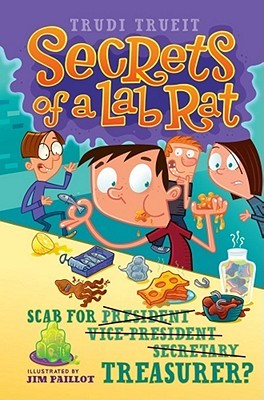
Scab for Treasurer?
by Trudy Trueit, illustrated by Jim Paillot
Scab, a self-proclaimed "lab rat," runs for class office, using wild and disgusting stunts to get voters' attention.
Violet Mackerel's Natural Habitat
by Anna Brandford, illustrated by Elanna Allen
Violet learns a hard lesson when she tries to keep a ladybug in captivity overnight.
Marty McGuire Digs Worms
by Kate Messner, illustrated by Brian Floca
As part of her class's effort to save the earth, Marty enlists her grandmother's help in raising worms.
Squish: The Power of the Parasite
by Jennifer L. Holm and Matthew Holm
Squish, a young amoeba, makes friends with a parasite whose sense of humor proves more cruel than funny.

by Annie Barrows, illustrated by Sophie Blackall
Ivy and Bean struggle to find a suitable project for the class's global warming unit.
The Jelly Bean Experiment
by David Adler
Daniel's unusual classmate, Calvin, uses him as the subject of a strange social experiment involving jelly beans.
Thursday, June 19, 2014
Choosing Books for Story Time


- Will this book engage the target age group?
This is usually the first question I ask about any given book, because if the book is not suited to the age group, nothing else matters. Books with few words and big, bold illustrations are probably best for baby story times. Toddlers like books with rhyme, animal sounds, and interactive elements. Preschoolers can follow longer plots and even make guesses about what might happen next. Books for story times for all ages might include some combination of all of these. The important thing is to think about the age group and choose a story that suits their developmental needs and interests. - Do I like this book?
As much as story time is about the kids and not the librarian, I think it’s important for the story time performer to choose books that she likes. I think kids can always tell when an adult is lukewarm about something she is reading, and I know I always do my best reading when I am enjoying myself. I can’t say I’ve never read a book I dislike at story time, but I can definitely say that my best story times have always happened when I’ve read titles I really love. - Is this book a good read-aloud?
Some picture books, beautiful though they might be to look at, do not make good read-alouds. Awkward rhyme schemes, difficult-to-pronounce character names, overly-complex sentences, and lack of connection between the illustrations and the text are all reasons that I would avoid reading a book aloud. I also avoid books that I just don’t feel comfortable performing. I will usually try to read a book aloud to myself, or even to a colleague, before I take it to story time, just to make sure it works and that I don’t feel awkward reading it to an audience. - Do I know any songs or rhymes that would pair really well with this book?
Though books are at the heart of story time, it’s usually not enough to just sit and read for thirty minutes. (Though I have had groups that prefer that approach.) Once I find a book I like, I think about what else I have in my repertoire on the same theme. It’s not absolutely essential that every book have a matching activity, but it helps a lot with the continuity of story time, and with narrowing down my options. I might still use a book for which I don’t have a matching song or rhyme, but I’m more likely to use a book that easily inspires other activities. - Are there other books on a similar theme?
I don’t always do themed story times, but sometimes a book will make me think of five other similar titles, and inspiration will strike. I also find it useful to look at a book from a variety of angles in order to brainstorm new themes I’ve never used before. This is also a great way to learn about books in my collection that I might not be familiar with, whether they turn out to be useful for story time or not. - Is the book difficult to hold?
Some books are just unwieldy. I find it impossible to effectively share a big book because I have never been able to find a way to hold it up that doesn’t require intense acrobatics. I also have a hard time holding up books with lots of flaps and fold-out pages. When I have an unusually shaped book, or a book with lots of parts to it, I always give it a test-run for an imaginary audience just to see whether I can even show the book to the group. If not, it doesn’t make it to story time. - Will those sitting in the back be able to see the pictures?
This question depends on the size of the audience as much as on the size of the book. If I’m doing story time for one hundred people in a large meeting space, I want to be sure the book is easily seen from the very back row of the room. If I have a smaller group I might just want assurance that kids within a couple of feet of me can see the pictures. The important thing is to choose a book that both kids and adults are easily able to see so they can engage with the visual elements of the story as well as the text. - Does this book encourage audience participation?
Not all story time books need to be interactive, but it helps to consider whether an audience participation element will engage or alienate your audiences. With larger groups, I like an opportunity to invite everyone to make animal sounds or repeat a particular refrain because it keeps the attention focused on the book instead of on the ten thousand distractions 100 toddlers can easily create for each other. With smaller groups that I know to be shy or quiet, though, I might not want to depend too heavily on audience participation because I know the kids will not participate and the mood in the room will be very uncomfortable.
Subscribe to:
Posts
(
Atom
)
