Thursday, October 16, 2014

Mommy Librarian's Story Time Secret #5: Sing Story Time Songs at Home

First I was a children’s librarian. Then I became a mom. As I attend story times with my daughter, I have started to make a list of hints that might be helpful to story time performers and/or story time attendees. Today’s hint is for the parents and caregivers who bring kids to story time: Sing story time songs at home!

Here's why you should sing story time songs at home:
  • Kids learn by repetition. Hearing the songs just a couple of times at story time is a good start, but they'll need to hear them again and again to fully absorb the tune, lyrics, and meaning.
  • Sometimes kids - especially babies - are distracted or overwhelmed by the unfamiliar environment and group of kids at story time, so they don't get a chance to participate fully. At home, in a comfortable and familiar place, they might react much differently to a song that didn't seem to interest them at all at the library. 
  • Singing is a great way to promote language skills, and especially to help your child hear the smaller sounds within words. 
  • You'll be able to participate better at story time. If you "practice" the songs at home, you can sing along with your librarian at the next story time session. (Trust me, she'll thank you!) 
  • It's fun! My daughter loves listening to me sing, and she makes it fun for me by dancing and giggling along. Even if you feel like you have a lousy singing voice, don't hesitate to share it with your child. He or she truly doesn't care whether you can carry a tune.
Do you sing story time songs with your kids at home? What are some of your favorites?

Tuesday, October 14, 2014

7+ Kids' Books Illustrated by Alexandra Boiger

Alexandra Boiger was born and raised in Munich, Germany, as the youngest of seven children. She studied graphic design and has worked for Dreamworks Animation. She is married to an Italian artist and they have one daughter. More information about Boiger and her work can be found on her website and in this interview with Mikela Prevost. Below is a list of selected works she has illustrated.

Novels & Chapter Books


  • In Roxie and the Hooligans by Phyllis Reynolds Naylor, nine-year-old Roxie is victimized by bullies until a strange set of circumstances places their survival in her hands.
  • The Magic Half by Annie Barrows is a time travel story about two girls living in the same house in different time periods who must find a way to change history before one of them loses her life. (Boiger illustrated the cover.)
  • Mrs. Piggle Wiggle by Betty MacDonald is the first book in a whimsical series about a magical elderly neighbor who knows all the tricks for transforming kids' bad behavior. Boiger illustrated the 2006 edition of this book, as well as three other reprints of titles in the series: Hello, Mrs. Piggle Wiggle, Mrs. Piggle Wiggle's Magic, and Happy Birthday, Mrs. Piggle Wiggle. (The books were originally illustrated by Hilary Knight of Eloise fame.)

Picture Books 


  • The Little Bit Scary People by Emily Jenkins encourages kids to look past "scary" appearances by imagining the possible hidden lives of the main character's interesting neighbors and family members.
  • In Thanks a Lot, Emily Post an historical picture book by etiquette book, but the kids want none of it.
  • Take Your Mama to Work Today by Amy Reichert follows a spirited little girl through a day at the office with her mom, during which she answers the phone, makes her own business cards, and uses the paper shredder.
  • Tallulah's Tutu by Marilyn Singer is the first of four books about a young aspiring ballerina who takes up dancing because she wants a tutu. The other books of the series are: Tallulah's Solo, Tallulah's Toe Shoes, and Tallulah's Nutcracker.

Monday, October 13, 2014

Great Books Not Yet Nominated for Cybils 2014

There are only a couple of days left in the nomination period for the 2014 Cybils, and there are a number of great titles that have surprisingly not been nominated yet! Below I have listed some of the books missing from the categories that I typically review. (Links are to Goodreads.)

This list was updated at 6 p.m. EDT on October 14.

Easy Readers

Early Chapter Books


Middle Grade Fiction 


Young Adult Fiction

Thursday, October 9, 2014

Learning Activities for Favorite Children's Books: Where the Wild Things Are


Where the Wild Things Are was published in 1963 and awarded the Caldecott Medal for "the most distinguished American picture book for children" in 1964. In the story, young Max puts on his wolf suit and makes mischief, prompting his mother to send him to bed without supper. That night, in Max's room a forest grows, and Max himself sails away to the land of the wild things, where he becomes their king. It's not long, however, before Max is ready to return home again, to the place where someone "loves him best of all." Below are four fun activities to accompany this beloved book.

Catch a Wild Thing Rhyming Game


Say the following chant: 

Eeny meenie miney moe
Catch a wild thing by the toe
If he hollers, let him go
Eeny meenie miney moe.


Pause before speaking the word "toe," and ask your child to fill in the blank with a body part rhyming with "moe." Repeat the rhyme, substituting for “moe” other sounds which rhyme with body parts (med, me, mere, etc.) For a more kinesthetic approach, have your child also put his hand on each part of the body as he calls out its name.

Go Wild! 


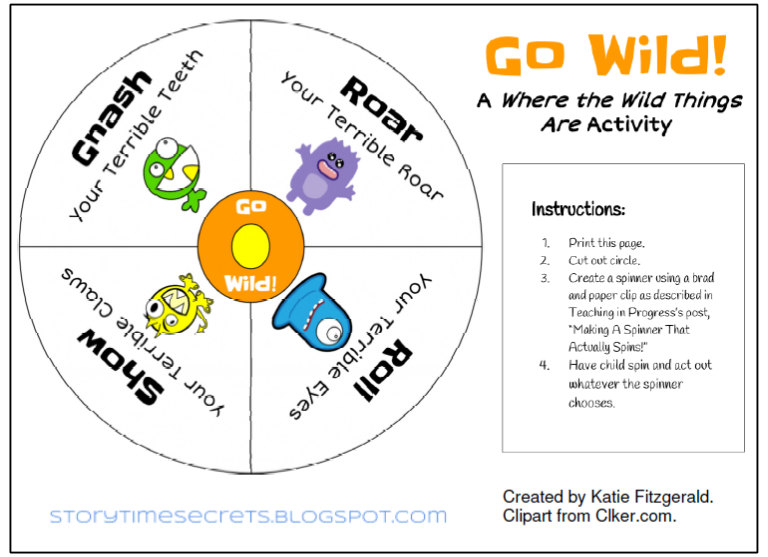
Have your own wild rumpus by roaring roars, gnashing teeth, showing claws, and rolling eyes just like the wild things do! Use the printable spinner below to determine which action your child should do. Play solo or take turns in a group.


Tame the Wild Things


Play a game of "Max Says." An adult or child can play the role of Max, who will call out a series of movements for the wild things to perform. If Max doesn't say, "Max says," the wild things should not do the action. Since Simon Says may be too difficult for many young children, another option is  to simply play follow the leader, where Max leads the wild things around the room, yard, or park, and the wild things must copy his moves.

M is for Max


Visit makinglearningfun.com, and print out two monsters - one sad, and one happy. Attach the monsters to popsicle sticks and hand them both to your child. Call out a series of words. Ask your child to hold up the smiling monster if the word you say begins with "M" as in Max and the frowning monster if it does not. This is a fun and simple way to practice listening to the sounds that begin words. For a greater challenge, ask your child to listen for the "M" sound at the end of the words, or anywhere within the words.

Related Posts Plugin for WordPress, Blogger...