Showing posts with label literacy. Show all posts

Friday, September 16, 2016

25 Ways to Play With Alexander and the Terrible, Horrible, No Good, Very Bad Day

Bad days happen to everyone - even kids! Published in 1972, this favorite picture book based on the author's own family is a great way to come to terms with those terrible, horrible days that make us want to move to Australia - and it's also a fun book to use for learning through play. Here are 25 ways to play with the content and themes of Alexander and the Terrible, Horrible, No Good, Very Bad Day.

  1. Create a homemade toy from a cereal box.  
  2. Draw what might be seen from the window of Alexander's carpool. 
  3. Practice singing loudly and softly. 
  4. Count to sixteen without leaving out any numbers. For an added challenge for older readers, count by sixteens! 
  5. Draw invisible pictures, like Alexander's invisible castle, using ink made of water and lemon juice.
  6. Use play food to pack a pretend lunch with all your favorite foods. 
  7. Spend some time in the kitchen making a dessert for your own lunch box - and don't forget to put it in before you leave for school! 
  8. Set up a make-believe dental practice. 
  9.  Pretend to be a shoe salesperson. 
  10. Color a pair of sneakers to suit your style. 
  11. Set up a pretend office like the one Alexander's dad works in. Act out the scene where Alexander visits the office.
  12. Find Australia on a map.
  13. Create an itinerary for traveling to Australia from your house.
  14. Sing Cuddly Koalas, about Australian animals.
  15. Plant a lima bean.
  16. Design a pair of ugly pajamas like the railroad train ones Alexander hates to wear.
  17. Write a sequel where Alexander has a good day. 
  18. Write a story about your own real or imagined bad day. 
  19. Hear Judith Viorst read the book in this video from Barnes and Noble's online story time feature. 
  20. Read Judith Viorst's other books about Alexander: Alexander, Who Used to Be Rich Last Sunday (1978), Alexander, Who's Not (Do You Hear Me? I Mean It!) Going to Move (1995), and Alexander, Who's Trying His Best to Be the Best Boy Ever (2014).
  21. Discover some of Judith Viorst's other books
  22. Watch the 2014 film adaptation of the book starring Steve Carell and Jennifer Garner.
  23. Watch the 1990 cartoon musical based on the book on YouTube. (Alexander is played by Danny Tamberelli!)
  24. Act out a skit based on the book using this script
  25. Retell the story using a flannel board set like this one

Wednesday, August 10, 2016

25 Ways to Play with The Pea Patch Jig

The Pea Patch Jig by Thacher Hurd was one of my favorite books in childhood, and I have loved sharing it with Little Miss Muffet. The book includes three linked stories about a baby mouse, whose mischievous behavior almost spoils her family's Midsummer Party, until it unexpectedly saves the day at the last minute. Here are 25 activities to do with your kids to delve deeper into the story and its themes.

  1. Listen to the song. The Pea Patch Jig is the name of a folk song. On the final page of the book, along with the music to play the tune, the author recommends listening to the version by Vassar Clements, John Hartford, Dave Holland. Hear it on YouTube
  2. Make up some dance moves. Encourage your kids to come up with their own version of the pea patch jig to match the music.
  3. Make a salad. Farmer Clem nearly chops up Baby Mouse when she hides in a head of lettuce that he picks for his salad. Include lettuce and some other veggie favorites in your own salad. 
  4. Explore peas in a sensory bin. Fill a tub with peas and provide your child with cups and spoons to scoop and pour them. For added fun, hide letters or toys and have your child hunt for them. For inspiration, check out these posts from Lessons4Learners.com and Gift of Curiosity.
  5. Make a pea shooter. Your (older) kids can pretend to save the day just like Baby Mouse with a simple pea shooter of their own! Instructions are available from Acorn Pies and Le Maison de LouLou
  6. Plan a midsummer party. Invite some friends over to join you for late afternoon celebration of summer. Be sure to serve fresh veggies and consider reading the book aloud to your guests.
  7. Cook and serve a dish made with peas. Kid-friendly recipes can be found on the Food Network's website.
  8. Make vegetable costumes. Baby Mouse and her family dress up as vegetables and dance at their Midsummer Party. Make your own costumes using patterns like the ones from burdastyle.com. Want to keep it simple? Try these fruit and vegetable masks from PrimaryTreasureChest.com.
  9. Plant your own vegetable garden. If you're like me and can't garden outdoors due to lack of space, try a container garden. 
  10. Make garden markers. If you already have a garden, or have a close friend or relative who has one, make some garden markers to clearly label what has been planted. I especially like these painted stones from Kitchen Fun with My Three Sons.
  11. Learn the names and uses for gardening tools. Whether you have a garden or not, you can still teach your child all about the tools gardeners use. This garden clip art set from kizclub.com is a great teaching tool. 
  12. Try some new vegetables. Each time we go to our local market for produce, we try to expose Little Miss Muffet to some new vegetables. If your kids are adventurous eaters, consider bringing home something new and different to taste.
  13. Visit a farmer’s market. If you're not sure where to find one locally, fear not! There's an app for that, as well as a national directory of farmer's markets.
  14. Compare Baby Mouse to Peter Rabbit. Both characters make mischief in gardens that do not belong to them. Compare and contrast these two stories to find out how else their main characters might be the same or different. 
  15. Read Keith Baker’s peas books. Keep the pea theme going by enjoying some of these wonderful books by Keith Baker: LMNO Peas, 1-2-3 Peas, Little Green Peas.  
  16. Play fruit and vegetable bingo. Print out these cards from Mama's Learning Corner and play a game of bingo.  
  17. Play fruit and vegetable I Spy. The Pleasantest Thing has a perfect printable to print out for this game.
  18. Make a farmer’s hat. Use these templates from First Palette to construct a paper hat, so you can pretend to be Farmer Clem. 
  19. Take a moonlit walk. Experience the atmosphere of the Midsummer Party by taking a walk outside under a full moon. 
  20. Retell the story. Use clip art to make cards or flannel board pieces of a baby mouse and some vegetables, and use them to retell the story or write a new one of your own. Kizclub.com has a mouse that would work well, as well as a set of vegetables.
  21. Do a pea-themed fingerplay. Five Fat Peas is a fun rhyme for babies, toddlers, and preschoolers.
  22. Sing Oats, Peas, Beans, and Barley Grow. The lyrics and tune can both be found here, as well as on Raffi's Baby Beluga album.
  23. Sing I Want to be a Farmer. This catchy folk song performed by Pete Seeger is fun to sing while acting out what a farmer might do. 
  24. Act out the African Planting Chant. This full-body action rhyme has a fun rhythm and a focus on planting seeds.
  25. Find out about foxes. Use a library book, database, or education video to learn more about the habits of foxes. 
For more ways to play with favorite children's books, check out my posts about Brown Bear, Brown Bear, What Do You See? and Whistle for Willie 

Tuesday, October 27, 2015

Learning Activities for Favorite Children's Books: 25 Ways to Play with Whistle for Willie

Ezra Jack Keats's 1964 picture book, Whistle for Willie, includes many examples of play, as Peter entertains himself in his neighborhood while also trying to learn how to whistle. Featured in the story are a traffic light, an empty carton, colored chalk, a mirror, Peter's father's hat, Peter's own shadow, a trip to the grocery store, and of course, Willie the dachshund. The activities on this list connect with these elements to help bring this classic story more fully to life for the youngest readers.
  1. Play Red Light Green Light. This classic game is a fun way to burn off excess energy and to reinforce the idea that red means stop and green means go. 
  2. Sing and dance to Turn Around by Hap Palmer. When Peter first discovers he can't whistle, he passes some time turning around and around until he makes himself dizzy.  This song, which is great for teaching kids to follow simple directions, is also perfect for spinning around and around. 
  3. Play a simple memory game using the motions of up, down, and around. Have your children take turns choosing whether to move up, down, or around. When it is his or her turn, each child must repeat the motions chosen by the previous players before adding a new one to the chain. See how long you can keep the chain going without forgetting the order! 
  4. Practice whistling. Young children may not be ready to learn to whistle, but they can still have fun practicing. If the experience proves too frustrating, let your kids blow a toy whistle instead. 
  5. Whistle rhythms. Whistle some notes in rhythm, then invite your child to copy you. 
  6. Play name that tune - with whistling. Whistle a favorite tune and have your child name the song. 
  7. Sing songs about whistling.  There are some great kid-friendly songs about whistling, including Whistle While You Work, Give a Little Whistle, and Whistle a Happy Tune. Turn one on and sing along! 
  8. Make shadows against a wall. Shine a flashlight against a blank wall and invite your kids to make shadow animals. 
  9. Do the "I'm Your Shadow" chant. This rhyme comes from a 1986 video, Clifford's Sing-Along Adventure, which we used to show after lunch at the special ed preschool where I worked for a while during library school. I have looked for it occasionally online and finally found it on YouTube here.
  10. Try on different hats and pretend to be different characters. Provide your child with some hats and see how her imagination comes to life as she imagines who might wear each one. 
  11. Match hats to their owners. Use this printable set from kizclub.com to match hats to the workers who wear them. 
  12. Play a memory game with a cardboard box. Lay out an array of objects, and invite your child to study them. Have your child look away for a moment, and hide one of the objects under a cardboard box. Then have him tell you which item is missing. (You could also do this with a group of children. Have one child leave the room and another hide under a box. Then have the child who was out of the room tell you who is hiding.) 
  13. Play dog-themed memory. Create your own memory cards, or use a printable set like this one from sunnydayfamily.com. 
  14. List words beginning with W. Whistle and Willie both begin with W. Challenge your child to come up with more words that also begin with this letter. 
  15. Make a whistle from a straw. There are instructions for this activity all over YouTube and Pinterest. Personally, I like these kid-friendly directions from Science Guy on YouTube.
  16. Balance on a piece of tape. Just as Peter balances on a crack in the sidewalk, challenge your child to walk along a piece of tape on the floor. Make this activity more challenging by putting lots of twists and turns in your tape "crack." 
  17. Draw a chalk line on the sidewalk (or on long paper). Imitate Peter by creating a long line right up to your front door. 
  18. Write and draw your own version of the story. Rewrite the first line of the book, "Oh, how Peter wished he could whistle!" by substituting your child's name and an activity he or she wishes to learn how to do. Then invite him or her to illustrate the sentence with a picture showing what it would be like to have that skill.  
  19. Make a dog like Willie. Use this wonderful template from Learn Create Love to create  your own dachshund like Willie. (Or, for a real keepsake, order these plush dogs from Discount School Supply and decorate with fabric markers.) 
  20. Listen to James Garner read the story. This vintage video from Bank Street College of Education is probably more fun for adults than for kids, but it's a decent performance of the book even if kids don't know who James Garner was. 
  21. Play a comprehension game based on the book. Make your own game board, or purchase this one from 2nd Grade Nemo at Teachers Pay Teachers. 
  22. Create your neighborhood in Keats's artistic style. Use collage materials to create a visual representation of your neighborhood and your favorite things to do there. 
  23. Draw your reflection. Provide your child with a mirror and invite him or her to draw his or her face the way it looks in the mirror. 
  24. Pretend to do grocery shopping. Set out some canned goods and other non-perishables and have your child pretend to go grocery shopping as Peter and Willie do at the end of the book. 
  25. Have a grocery store scavenger hunt. When you visit the actual grocery store, give your kids lists of items to locate. Hands On As We Grow has some great ideas for this activity. 

Thursday, September 17, 2015

Learning Activities for Favorite Children's Books: 25 Ways to Play With Brown Bear, Brown Bear, What Do You See?

Brown Bear, Brown Bear, What Do You See? by Bill Martin Jr. and Eric Carle, originally published in 1967, is a perennial story time favorite which has taken on new significance for me since I now have a toddler old enough to appreciate it. Though the concept of the book is simple, it is amazing how much kids connect with it, and how they never tire of hearing the same repeated phrases. Because the way young children experience the world is through play, today I am sharing a list of 25 ways you can play with your child using the text, pictures, and themes of this book as inspiration.

  1. Sing the story. Each page of text in this book matches up to the first part of "Twinkle Twinkle Little Star." Change up your read-aloud style a little bit by singing each page, instead of simply speaking the words. 
  2. Hear the author chant the book. Bill Martin, Jr. died in 2004, but there is a video onYouTube featuring his own unique reading of the text. Have fun chanting along with the familiar words. 
  3. Sing "Colorful Morning." The clever librarians in the King County Library System have written a piggyback song based on When Ducks Get Up in the Morning that focuses on colors. Once you've read the book, reinforce your child's knowledge of colors by singing and acting out this fun song. 
  4. Clap, tap, or shake to the rhythm of the text. As Bill Martin Jr.'s reading above demonstrates, the text of this book has a great, consistent rhythm. Help your child feel the beat by encouraging him to clap his hands, tap on a drum, or shake a maraca or shaker egg as you read the text.
  5. Sing "I Can Sing a Rainbow." This song celebrates both colors and imagination, just like Eric Carle's illustrations. Play the song on the ukulele, or look for the Fred Penner recording. 
  6. Act out "Rainbow Over the Waterfall." Take a break between readings of the book for your child to move her body like a rainbow following the directions in this action rhyme by Jean Warren. 
  7. Play Fill-in-the-Blanks.  Pause periodically as you read the story and allow your child to fill in a missing word or two. This is a great way to help pre-readers begin to understand how sentences are constructed and how rhyme works.
  8. Tell your own version of the book personalized to your child. Line up your child's favorite colorful toys (animals, shapes, peg dolls, etc.) and ask each one what it sees. At the end, repeat everything in the line-up, just as the author does on the final page of the story. 
  9. Play I Spy and talk about what you can see. After asking each of the animals in the book what it sees, turn the tables and ask your child. Give as many clues as necessary to help your little one figure out what you're looking at, then invite him or her to spy his own object for you to guess.
  10. Play Brown Bear Bingo. Use these printable templates from Making Learning Fun to create a set of Bingo cards.  As you read the story, have your children mark the squares on their cards for each animal as it is named. Alternatively, call out the names of the animals independently of reading the book and award a prize to the first child who calls out Bingo. (This would be a great birthday party game!) 
  11. Read and color. Some kids listen better when they have something to do with their hands. Lay out some crayons and provide your child with a copy of DLTK's printable Brown Bear coloring pages. As you identify each animal by color, have your child color the appropriate page with the correct color.
  12. Draw or paint a favorite animal from the story. Is your child especially attached to one specific animal named in the book? Encourage her fascination with this animal by inviting her to create her own using art supplies.
  13. Draw or paint an animal using an unusual color. Eric Carle's illustrations include a purple cat and a blue horse. Encourage your child to think outside of the box and reimagine an animal in a different color or pattern, then have them put the idea to paper.
  14. Share "The Artist's Crayons" on the flannel board. Celebrate the creativity of a true artist by singing my piggyback song based on "Mary Wore Her Red Dress," in which an artist creates a rainbow over the course of several days. 
  15. Use masks to dress up as each of the story's animals. Using paper plates, brown paper bags, or other simple supplies, make a mask to represent each animal named in the story. Then read the story as your child acts out the role of each animal. (Or, invite over a few friends and put the story on as a skit!)
  16. Make different-colored glasses. Allow your child to see the world in different hues by creating pairs of silly glasses with pieces of colored cellophane as the lenses. There are wonderful printable templates for making glasses at First Palette. A similar activity has also been posted by What Do We Do All Day?
  17. Practice naming colors on the end papers. The end papers of the book show all the colors featured in the story. After a few readings, test your child's color knowledge by seeing how many he can name.
  18. Use colored strips of paper to recall and retell the story. Hold up strips of colored construction paper and ask your child to name the animal that goes with that color. Then check the book to see how many she gets right! 
  19. Make the sounds of the animals. Though this is one of the few animal books for toddlers that doesn't focus on animal sounds, it is still fun to add them in. (It's also funny to hear kids' interpretation of what they think a goldfish might say!)
  20. Act out the story by moving like the animals. Most of the animals in this book have a distinctive motion that sets them apart from the others. As you read the story, invite your child to pretend to be each of the animals. 
  21. Tell the story with stick puppets. Because this story is so simple and easy to memorize, it is a great one to act out and retell. Using the same coloring pages from DLTK (also linked above) create some popsicle stick puppets and tell the story in a new way.  
  22. Play Brown Bear charades. Have your child act out an animal from the story without using words and see if you can guess which animal he is meant to be. Then switch roles and allow him to guess! 
  23. Paint like Eric Carle. Eric Carle has a very distinct artistic style that you can recreate with your kids using basic art supplies. See one librarian's approach to this project at In Short, I Am Busy
  24. Name colored objects to match each animal. Pause after reading each page and see how many objects of the same color your child can name. When she runs out of ideas, move onto the next page. 
  25. Imagine changes to the story. On his blog, back in 2010, Eric Carle talked about the different changes this book has undergone since its original publication, including some  versions where the teacher is replaced by a mother, or even a monkey! Encourage your child to reimagine the book in different ways and discuss how this might change how they feel about it. 
Do you and your kids enjoy classic children's books? Also check out my learning activities to accompany Caps for Sale, May I Bring a Friend?, and Where the Wild Things Are

Thursday, January 29, 2015

Learning Activities for Favorite Children's Books: May I Bring a Friend?


May I Bring a Friend? was written by Beatrice Schenk de Regniers and illustrated by Beni Montresor. It was published in 1964 and received the Caldecott Medal in 1965. In the story, the king and queen invite a young boy to their castle each day for a different meal or celebration. The boy inquires whether he may bring a friend to each of these visits, then shows up every time with a different zoo animal. The following are extension activities to share after reading the book.

I’m Looking for a Friend


Create flannel board pieces of the animals which appear in the story - giraffe, rhinoceros, monkey, elephant, lion, and seal - and line them up on the flannel board. Tell your child you are looking for a specific friend,then give a description of one of the animals. (For example, “I am looking for a friend with a long neck.” ) Have your child locate and remove the correct animal from the flannel board. Then allow your child to take a turn giving the clues and allow you to guess. This game can also be played on a tabletop.

Clipart images of the animals can be found on kizclub.com in the following documents:

Feed the Animals


Use the animals you created for the game above along with the linked images of food below to play a matching game. Decide which animal would be most likely to eat each food and “feed” the animal by placing the food next to it on the flannel board or table top.

King and Queen Match-Up


The kings and queens in the printable document below each bear the name of a day of the week. Mix them up and have your child match King Monday with Queen Monday, King Tuesday with Queen Tuesday, etc.


Cut & Paste Calendar


Using the printable calendar below, have your child retell the story by cutting and pasting the appropriate animals and foods into the space for each day of the week. (Lunch is represented by a sandwich, and Halloween by a jack o’lantern.)


For more learning activities for favorite children's books, click here.

Thursday, November 13, 2014

Learning Activities for Favorite Children's Books: Caps for Sale


Caps for Sale by Esphyr Slobodkina - a Russian woman - was published in 1938. Though she wrote other books, this is her best-known work. In the story, a peddler carries the caps he sells on his head in a particular order. One day, when he dozes off beneath a tree, a bunch of monkeys snatch the caps, and the peddler must find a way to outsmart them and get them back. Here are four games to play to enrich your child's reading experience with this book.

Sort the Caps 

Each of the caps in the printable set below has a different three-letter word printed on it.  Ask your child to sort the caps according to different criteria - same first letter, same last letter, same middle sound, rhyming words, etc. Younger children can also sort the caps by color.


Monkey See, Monkey Do Game


The nine cards in this printable document have instructions for making different monkey-like movements. Have your child select one card at a time from the stack of cards (or from a bag or basket), read the instructions, and act them out. 


Monkey, Monkey, Where's My Cap? 

In this game, your child must discover behind which monkey a cap is hidden. The printable game includes 8 monkeys, each labeled with a capital letter, and four caps, one in each of the colors mentioned in the book. The pieces can be cut out and laminated for use on a flannel board or magnet board, used as models for your own felt pieces, or used on a flat table top.


When it is time to guess, say this simple rhyme:

Monkey, monkey, where’s my cap?
I know you took it. Now give it back!

Then ask your child to call out which monkey he thinks has taken the cap. The game ends when the cap has been found. For a bigger challenge, hide multiple hats and ask your child to guess which color hat is hidden where.

Which Cap is Missing?

Using the caps from the games above, play a memory-building game. Show your child an array of caps on a tray or tabletop, then have her hide her eyes while you take one away. When she opens her eyes, ask her to tell you which cap is missing.

Thursday, October 9, 2014

Learning Activities for Favorite Children's Books: Where the Wild Things Are


Where the Wild Things Are was published in 1963 and awarded the Caldecott Medal for "the most distinguished American picture book for children" in 1964. In the story, young Max puts on his wolf suit and makes mischief, prompting his mother to send him to bed without supper. That night, in Max's room a forest grows, and Max himself sails away to the land of the wild things, where he becomes their king. It's not long, however, before Max is ready to return home again, to the place where someone "loves him best of all." Below are four fun activities to accompany this beloved book.

Catch a Wild Thing Rhyming Game


Say the following chant: 

Eeny meenie miney moe
Catch a wild thing by the toe
If he hollers, let him go
Eeny meenie miney moe.


Pause before speaking the word "toe," and ask your child to fill in the blank with a body part rhyming with "moe." Repeat the rhyme, substituting for “moe” other sounds which rhyme with body parts (med, me, mere, etc.) For a more kinesthetic approach, have your child also put his hand on each part of the body as he calls out its name.

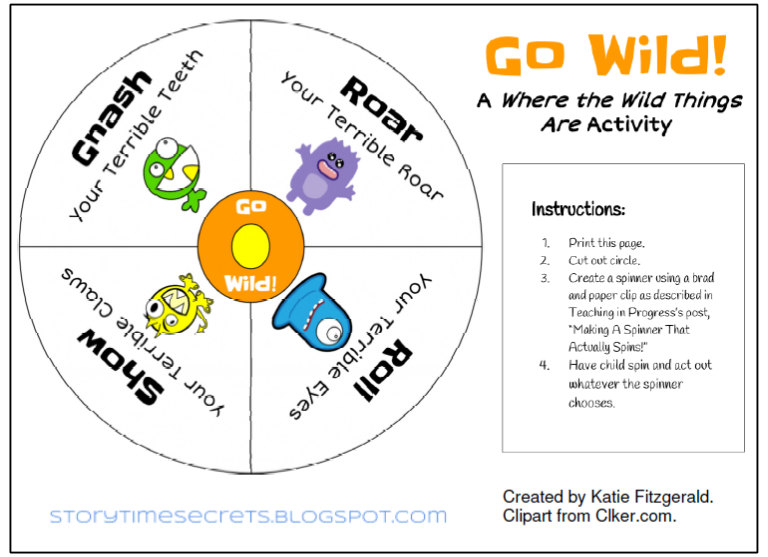
Go Wild! 


Have your own wild rumpus by roaring roars, gnashing teeth, showing claws, and rolling eyes just like the wild things do! Use the printable spinner below to determine which action your child should do. Play solo or take turns in a group.


Tame the Wild Things


Play a game of "Max Says." An adult or child can play the role of Max, who will call out a series of movements for the wild things to perform. If Max doesn't say, "Max says," the wild things should not do the action. Since Simon Says may be too difficult for many young children, another option is  to simply play follow the leader, where Max leads the wild things around the room, yard, or park, and the wild things must copy his moves.

M is for Max


Visit makinglearningfun.com, and print out two monsters - one sad, and one happy. Attach the monsters to popsicle sticks and hand them both to your child. Call out a series of words. Ask your child to hold up the smiling monster if the word you say begins with "M" as in Max and the frowning monster if it does not. This is a fun and simple way to practice listening to the sounds that begin words. For a greater challenge, ask your child to listen for the "M" sound at the end of the words, or anywhere within the words.

Related Posts Plugin for WordPress, Blogger...